Mud Slab (Dalle de Tréfond): definition, construction & waterproofing
The mud slab -- known as dalle de tréfond in Quebec construction -- is a critical component of commercial building foundations. This thin concrete slab, poured directly on compacted gravel at the bottom of an excavation, provides a clean working surface for waterproofing membranes and under-slab insulation before the structural slab is placed. This guide covers its purpose, construction and best waterproofing practices.
In Quebec commercial construction, a mud slab (French: dalle de tréfond or simply tréfond) is a thin, non-structural concrete slab -- typically 50 to 75 mm (2 to 3 inches) thick -- poured directly on compacted gravel or soil at the bottom of an excavation. The mud slab is placed before the main structural slab. It creates a clean, level working surface that allows the installation of waterproofing membranes, vapour barriers and rigid under-slab insulation. HIZO works on mud slabs across Quebec, applying liquid membranes, polyurea coatings and under-slab insulation on commercial and institutional job sites.
Why pour a mud slab (dalle de tréfond)
Clean working surface
The mud slab provides a flat, dry surface for workers, eliminating the need to work on loose gravel or mud at the bottom of the excavation.
Membrane substrate
It provides a smooth, rigid substrate for the application of liquid or sheet waterproofing membranes under the structural slab.
Insulation base
Rigid insulation (extruded polystyrene) is laid flat on the waterproofed mud slab, ensuring optimal thermal performance under the structural slab.
Moisture barrier
Even without an additional membrane, the concrete mud slab slows capillary moisture rise from the soil into the structural slab above.
Rebar & services placement
The level surface allows precise positioning of reinforcing steel, mechanical conduits and under-slab plumbing before the structural pour.
Water table management
In areas with a high water table, the mud slab temporarily contains hydrostatic pressure during foundation work.
How to build and waterproof a mud slab
Mud slab placement
The mud slab is poured directly on a compacted gravel layer (clear stone or MG-20) that is typically 150 to 300 mm (6 to 12 inches) thick. The gravel ensures sub-slab drainage and breaks the capillary rise of moisture. A standard mud slab is 50 to 75 mm (2 to 3 inches) of plain concrete, sometimes reinforced with light welded wire mesh or fibers.
Unlike the structural slab, the mud slab carries no permanent loads. Its role is strictly functional: to create a working platform for the next stages of construction.
- Thickness: 50 to 75 mm (2 to 3 in.)
- Plain concrete (non-structural)
- Poured on compacted gravel
- Troweled smooth to receive membrane
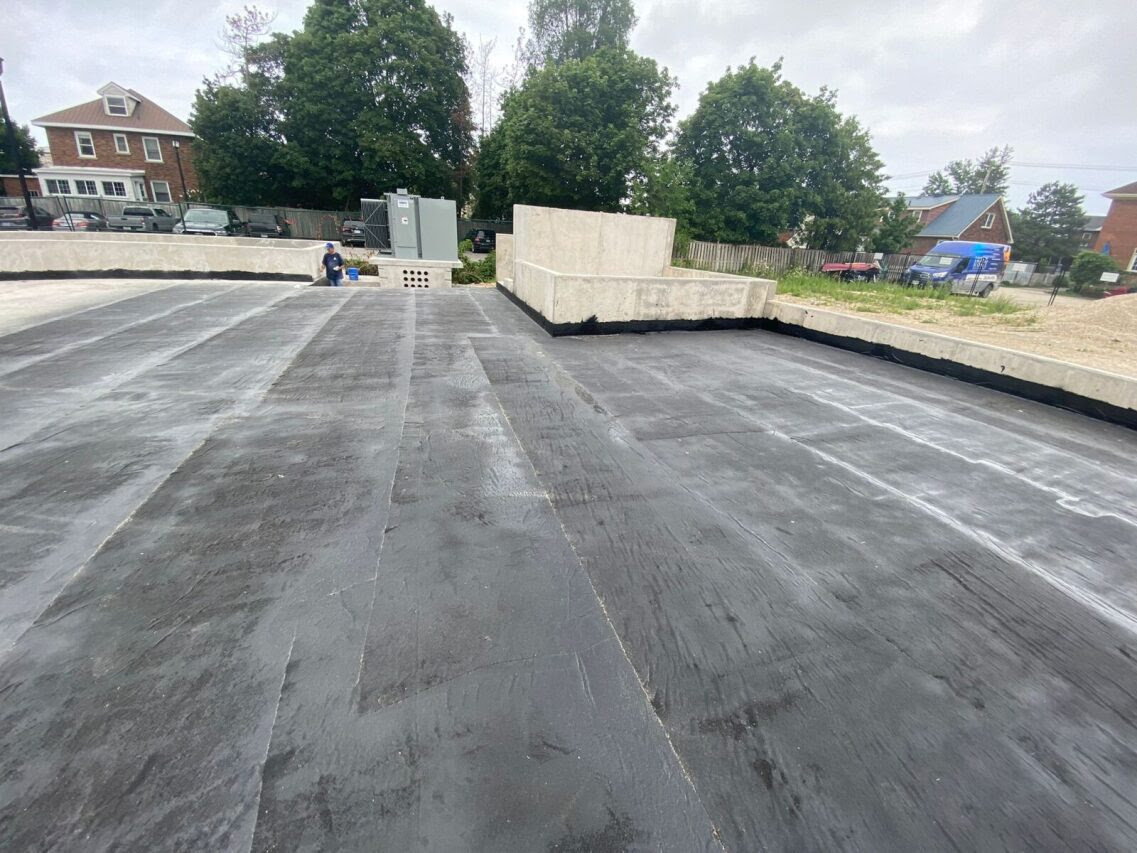
Liquid membrane waterproofing
Once the mud slab has cured, HIZO applies an elastomeric liquid membrane directly to its surface. This membrane forms a continuous, seamless film that prevents water and soil moisture from rising through the structural slab poured above.
Liquid membrane is the preferred method on mud slabs because it conforms perfectly to the surface, fills minor irregularities and transitions easily to foundation wall tie-ins.
- Continuous seamless film
- Conforms to surface irregularities
- Easy tie-in to foundation walls
- Resists hydrostatic pressure
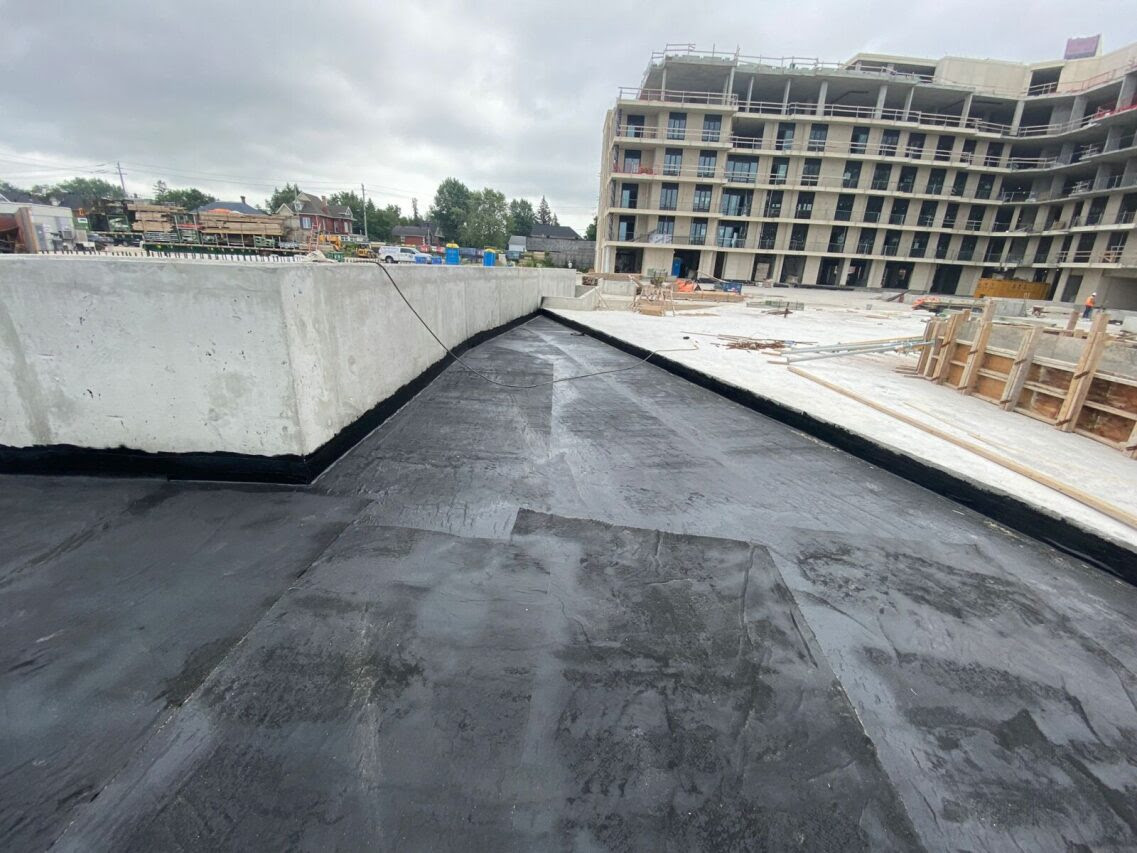
Polyurea & under-slab insulation
For projects requiring superior mechanical resistance, HIZO applies spray-applied polyurea coating on the mud slab. Polyurea cures in seconds and forms an extremely abrasion- and puncture-resistant membrane, ideal when heavy rebar and mechanical conduits will be installed above.
After waterproofing, rigid extruded polystyrene (XPS) insulation boards are laid on the membrane to break the thermal bridge between the ground and the structural slab. This under-slab insulation reduces heat loss and prevents condensation.
- Near-instant cure time
- Superior mechanical resistance
- XPS insulation over membrane
- Thermal bridge elimination
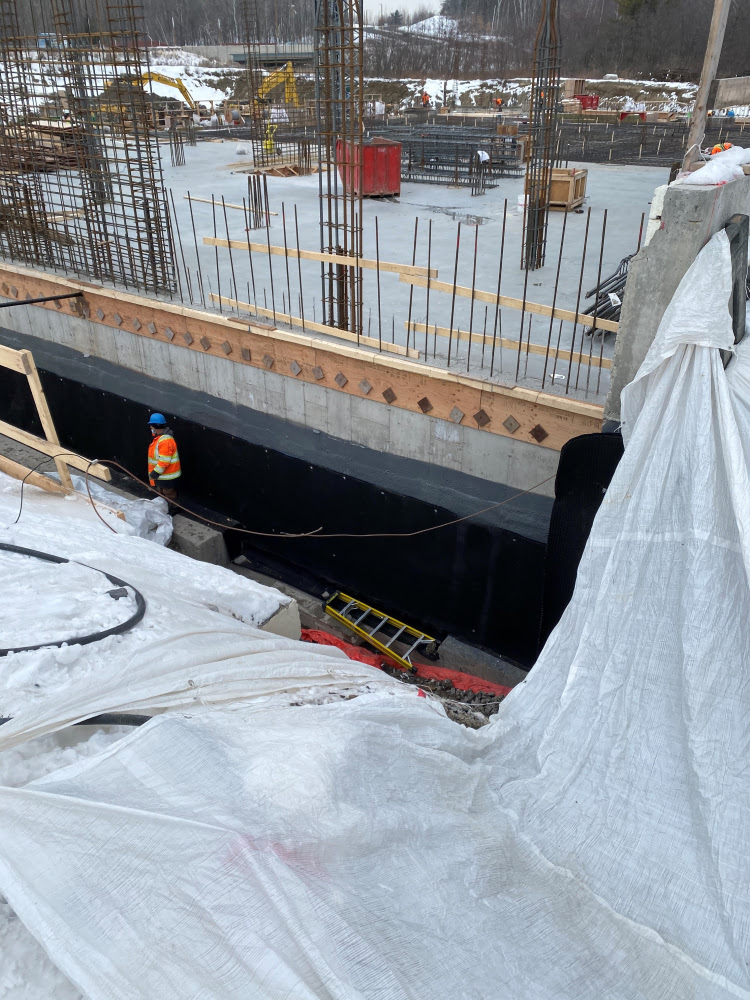
Challenges with mud slabs
Capillary moisture rise
Without a membrane, soil moisture passes through the mud slab and deteriorates the insulation and structural slab above.
Hydrostatic pressure
Where the water table is high, water can push up under the mud slab and infiltrate through cracks or cold joints.
Shrinkage cracking
The thin, lightly reinforced mud slab is prone to shrinkage cracks. A waterproofing membrane bridges these cracks effectively.
Thermal bridging
Without insulation between the mud slab and structural slab, ground cold transfers directly to the building floor above.
Everything about mud slabs (dalle de tréfond)
What is a mud slab (dalle de tréfond)?
A mud slab (French-Canadian construction term: dalle de tréfond or simply tréfond) is a thin layer of non-structural concrete, typically 50 to 75 mm (2 to 3 inches) thick, poured directly on compacted gravel at the bottom of an excavation. It serves as a clean, level working surface for installing waterproofing membranes, rigid insulation and positioning reinforcing steel before the main structural slab is poured. Mud slabs are standard practice in commercial and institutional construction in Quebec.
How thick is a mud slab?
A standard mud slab is 50 to 75 mm (2 to 3 inches) thick. Some specifications call for 100 mm (4 inches) on projects with a high water table or when greater durability is required. The slab is poured in plain concrete, sometimes reinforced with fibers or light welded wire mesh to limit shrinkage cracking.
How do you waterproof a mud slab?
Mud slab waterproofing is typically done by applying an elastomeric liquid membrane or spray-applied polyurea coating to the top surface. The membrane forms a continuous, seamless film that prevents water and soil moisture from rising upward. It is then covered with rigid insulation (XPS) and finally the structural slab. HIZO applies these membranes on commercial job sites throughout Quebec.
Do you need insulation above a mud slab?
Yes. Insulation between the mud slab and the structural slab is essential to break the thermal bridge between the cold ground and the building floor. High-density extruded polystyrene (XPS) boards are laid on the waterproofing membrane. This under-slab insulation reduces heat loss, prevents condensation and improves occupant comfort. The Quebec Building Code prescribes minimum R-values for under-slab insulation.
Our mud slab waterproofing projects
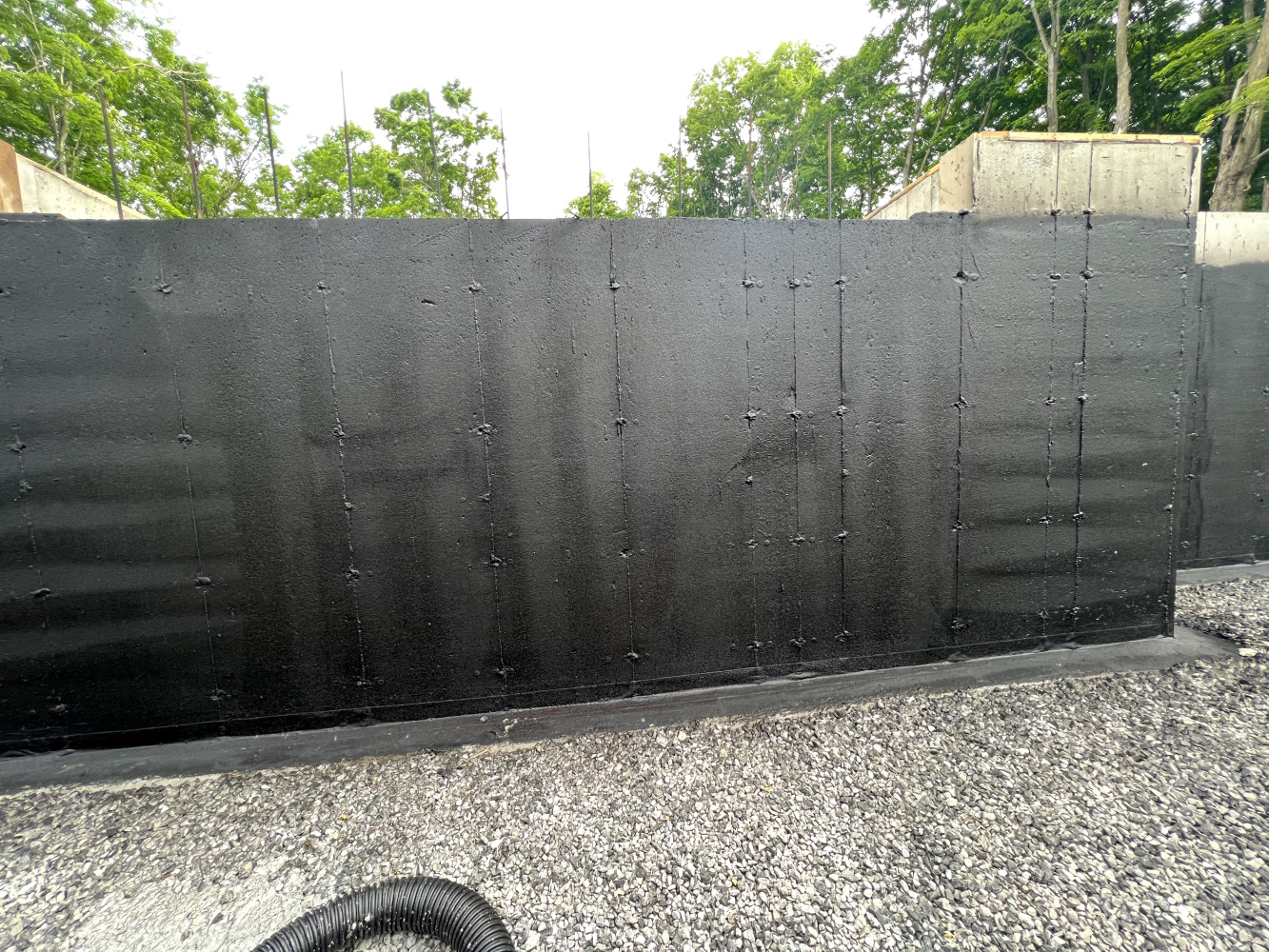
Need mud slab waterproofing?
Our experts apply waterproofing membranes and under-slab insulation on commercial and institutional job sites across Quebec.